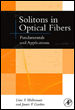
Solitons in Optical Fibers: Fundamentals and Applications
Chapter 7: Polarization and Its Effects

7.1 Apologia

Thus far in this book, we have tended to gloss over polarization and effects of the fiber's birefringence on it. That is, for the most part, we have been content to note the thorough polarization averaging, created by the fiber's random residual birefringence, over those distances for which the nonlinear term has significant effects. We have used that averaging to justify further neglect of polarization. Nevertheless, there are certain important polarization phenomena that require examination. One of these is called polarization-mode dispersion, PMD for short, which makes the transit time for a pulse dependent on its polarization history and produces some dispersive wave radiation in the process. The other is the fact that colliding solitons in WDM alter each other's polarization states. Therefore, we now examine the linear birefringence of fibers and its statistical properties, the birefringence induced nonlinearly by the pulse itself, and the effects of both on transmission. A review of the basic properties of PMD in linear transmission lines is given in Gordon and Kogelnik [ [97]].

[97]J. P. Gordon and H. Kogelnik, "PMD fundamentals: Polarization mode dispersion in optical fibers," Proc. Nat. Acad. Sci. U.S.A., vol. 97, pp. 4541 4550, April 2000.

7.2 Polarization States and the Stokes-Poincar Picture

If z is the propagation direction, and and are unit vectors in the x and y directions, respectively, a unit normalized polarization vector can be written as , where r and s are complex numbers...

UNLIMITED FREE
ACCESS
TO THE WORLD'S BEST IDEAS

SUBMIT
Already a GlobalSpec user? Log in.

This is embarrasing...

An error occurred while processing the form. Please try again in a few minutes.

Customize Your GlobalSpec Experience

Category: Fiber Optic Circulators
Finish!
Privacy Policy

This is embarrasing...

An error occurred while processing the form. Please try again in a few minutes.