In previous chapters, we have discussed only single solitons in the absence of noise fields (radiation) or other solitons. In a typical communication system, there will be many solitons in each channel as well as many different channels, and there will be noise, so it is important to understand their interactions. In this chapter, we discuss the theory of soliton collisions in different WDM channels, that is, of solitons of significantly different frequencies. Also, we apply some results of the inverse scattering transform (IST) to the interaction of small linear noise fields with solitons, and to the interaction of solitons in the same channel, that is, with the same central frequency, that get close together in time. For the highest possible bit rates, one wants the solitons in each channel as close together in time as possible, and the channels as close together in frequency as possible.
4.1 Soliton-soliton Collisions in WDM
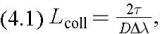
In WDM, solitons of different channels gradually overtake and pass through each other (see Fig. 4.1). Because the solitons interact with each other, the time of overlap is known as a "collision." An important parameter here is the collision length, L coll, or the distance the solitons must travel down the fiber together in the act of passing through each other. If L coll is defined to begin and end with overlap at the half-power points, then transparently
 Figure 4.1: Two stages of a soliton-soliton collision. Because of the anomalous group velocity dispersion, the shorter wavelength...
Copyright Elsevier Inc. 2006 under license agreement with Books24x7


 TABLE OF CONTENTS