Specialty Optical Fibers Handbook

Stephen Montgomery
ElectroniCast Corp., San Mateo, California
ElectroniCast has studied the potential use and market consumption for a variety of specialty optical fibers. All of the fiber types studied show very impressive historic and future growth potential. A few of the near-term standouts in value potential include polarization (PZ), ytterbium-doped, dispersion-compensating, and photosensitive fibers. Growth is also foreseen for new more esoteric and highly advanced fibers, such as holey fibers (photonic crystal fibers).
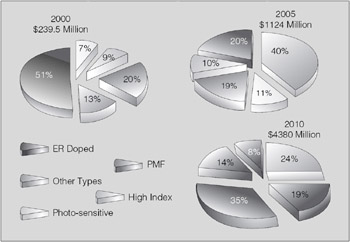
The global consumption of selected specialty optical fibers which is composed of actual product sales and research and development (R&D) production has been expanding rapidly from $239 million in 2000 to reach a forecasted estimate of $4380 million by 2010 (Fig. 1.1). This growth is driven by the challenges presented by the requirements of greater distances (kilometers/link lengths), optical fiber amplifiers (OFAs), dispersion compensation, attenuation, higher data rates, increased number of wavelengths (DWDM), high-powered fiber lasers, and simply the increase in the number of applications, components, and modules just to name a few drivers.
The actual consumption (use) of specialty optical fibers in internal and external R&D applications and in commercial consumption exceeded the production rates in recent years. This factor has since been corrected, because earlier excess inventory of fiber has been absorbed to more manageable levels.
At all levels in the fiber optic industry food chain, there is general agreement that there has been a return to substantial growth, which...