Specialty Optical Fibers Handbook

John B.MacChesney, 1 Ryan Bise, 1 and Alexis M ndez 2
1 OFS Bell Labs, Murray Hill, New Jersey
2 MCH Engineering LLC, Alameda, California
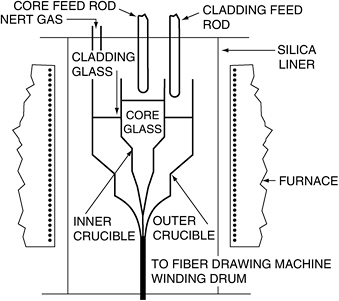
The first attempt at producing high-purity glass, the so-called double-crucible technique, proceeded along the lines of conventional glass melting but used specially prepared constituents [1, 2]. Soda-lime-silicate and sodium-borosilicate glasses were made from materials purified to parts-per-billion (ppb) levels of transition metal impurities by ion exchange, electrolysis, recrystallization, or solvent extraction. These starting glasses were melted, fined, drawn to cane, and fed into an ingenious continuous casting system composed of concentric platinum crucibles, shown in Fig. 3.1. A thin stream of core glass flowed from the upper crucible, passed through the reservoir of cladding glass, and was concentrically surrounded by the cladding as it flowed through the orifice of the lower thimble. The time and temperature of core-cladding contact in the cladding reservoir were controlled, enabling diffusion to produce the index gradient needed to minimize intermodal dispersion.
Despite its elegance, overwhelming problems beset this method from the start. First, contamination during processing raised the impurity level from the ppb level in the constituents to parts-per-million (ppm) levels in the fiber. Many attempts were made to eliminate this contamination and a partial solution was achieved by using the oxygen partial pressure of the atmosphere during processing to control the redox conditions within the molten glass. Absorption by iron and copper, the two principal contaminants, could thus be...