Specialty Optical Fibers Handbook

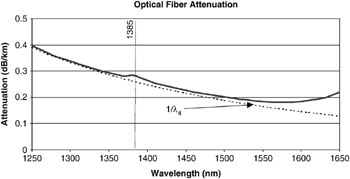
Optical intensity of light decreases during transmission in a straight fiber because of various absorption and scattering mechanisms. This is represented mathematically in Eq. (2.3) when the longitudinal propagation constant, ?, is a complex number. The imaginary part of ? is the longitudinal decay constant. The decrease in optical power during transmission is often referred to as attenuation or loss. For modern silica-based fibers, the attenuation within the wavelength range from about 1300 to 1600 nm is dominated by Rayleigh scattering, which results from intrinsic nanoscopic density fluctuations in the glass. Rayleigh scattering loss has wavelength dependence approximately 1/ ? 4 [27], as illustrated in the dashed line in Fig. 2.7.
In addition, sources of attenuation in optical fibers result from electronic and vibrational absorption from the silica, intended dopants, and impurities, and possibly from scattering by stress patterns frozen into the core layers during draw. The most commonly used model for the spectral loss, ?, in dB/km has been
where A is the Rayleigh scattering coefficient, B represents the combined wavelength-independent scattering loss mechanisms such as microbending, waveguide imperfections, and other scattering losses, and C( ?) represents all other wavelength-dependent loss mechanisms such as the OH ? absorption peaks. Walker [28] proposed modeling C( ?) as
where the UV absorption band edge is modeled by