Specialty Optical Fibers Handbook

2.9: MICROBENDING LOSS

2.9 MICROBENDING LOSS

2.9.1 Microbending

Fibers often exhibit excess loss when they are spooled or cabled as the result of small deflections of the fiber axis that are of random amplitude and are randomly distributed along the fiber. The loss induced in optical fiber by these small random bends and stress in the fiber axis is called microbending loss.

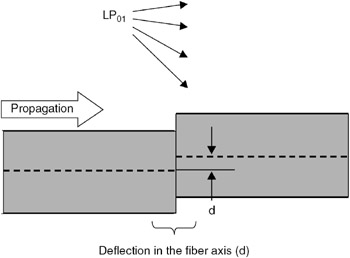
Figure 2.16 cartoons the impact of a single microbend, at which, analogous to a splice, power can be coupled from the fundamental mode into higher order leaky modes. Because external forces are transmitted to the glass fiber through the polymer coating material, the coating material properties and dimensions, as well as external factors, such as temperature and humidity, affect the microbending sensitivity of a fiber. Further, microbending sensitivity is also affected by coating irregularities such as variations in coating dimensions, the presence of particles such as those in the pigments of color coatings, and inhomogeneities in the properties of the coating materials that vary along the fiber axis. Coating surface slickness can also affect the mechanical state into which a fiber relaxes after spooling or within a cable structure, thereby affecting microbending loss.


Figure 2.16: Model of the core of a fiber in the vicinity of a highly exaggerated microbend. Power carried in the fundamental mode before the microbend is coupled into the fundamental as well as higher order modes at the microbend, similar to the case of a non-ideal splice.

The fiber axis perturbations that cause microbending loss are random...

UNLIMITED FREE
ACCESS
TO THE WORLD'S BEST IDEAS

SUBMIT
Already a GlobalSpec user? Log in.

This is embarrasing...

An error occurred while processing the form. Please try again in a few minutes.

Customize Your GlobalSpec Experience

Category: Fiber Optic Attenuators
Finish!
Privacy Policy

This is embarrasing...

An error occurred while processing the form. Please try again in a few minutes.