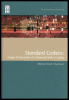
Standard Codecs: Image Compression to Advanced Video Coding
In the mid 1980s joint work by the members of the ITU-T (International Telecommunication Union) and the ISO (International Standards Organisation) led to standardisation for the compression of grey scale and colour still images [1]. This effort was then known as JPEG: the Joint Photographic Experts Group. As is apparent, the word joint refers to the collaboration between the ITU-T and ISO. The JPEG encoder is capable of coding full colour images at an average compression ratio of 15:1 for subjectively transparent quality [2]. Its design meets special constraints, which make the standard very flexible. For example, the JPEG encoder is parametrisable, so that the desired compression/quality trade-offs can be determined based on the application or the wishes of the user [3].
JPEG can also be used in coding of video, on the basis that video is a succession of still images. In this case the process is called motion JPEG. Currently, motion JPEG has found numerous applications, the most notable one being video coding for transmission over packet networks with unspecified bandwidth or bit rates (UBR). A good example of UBR networks is the Internet where, due to unpredictability of the network load, congestion may last for a significant amount of time. Since in motion JPEG each frame is independently coded, it is an ideal encoder of video for such a hostile environment.
Another application of motion JPEG is video compression for recording on magnetic tapes, where again the independent coding of pictures increases the flexibility of the...