Standard Codecs: Image Compression to Advanced Video Coding
9.9: Buffer regulation

9.9 Buffer regulation

Regulation of output bit rates for better distribution of the target bit rate among the encoding parameters is an important part of any video encoder. This is particularly vital in the H.263 encoder, at least for the following reasons:

  • better bit rate regulation requires larger buffer sizes, hence longer delays

  • H.263 is intended for visual telephony, and the encoding delay should be limited, hence smaller buffer sizes are preferred

  • the target bit rate is in the order of 24 kbit/s, and even small size buffers can introduce long delays.

There is no best known method for buffer regulation, and Recommendation H.263 does not standardise any method (neither do other standard encoders). However, at least for the laboratory simulations, one can use those methods designed for the test models. The following is a method that can be used in the simulations [5]. The bit rate is controlled at a macroblock level, by changing the quantiser parameter, Q P, depending on the bit rate, the source and target frame rates.

For the first picture, which is intraframe coded, the quantisation parameter is set to its mid range Q P = 16 ( Q P varies from 1 to 31). After the first picture, the buffer content is set to:

(9.17)

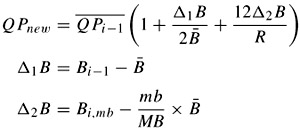
For the following pictures the quantiser parameter is updated at the beginning of each new macroblock line. The formula for calculating the new quantiser parameter is:

(9.18)

where:

=

mean quantiser parameter for the previous picture

UNLIMITED FREE
ACCESS
TO THE WORLD'S BEST IDEAS

SUBMIT
Already a GlobalSpec user? Log in.

This is embarrasing...

An error occurred while processing the form. Please try again in a few minutes.

Customize Your GlobalSpec Experience

Category: Insulated Gate Bipolar Transistors (IGBT)
Finish!
Privacy Policy

This is embarrasing...

An error occurred while processing the form. Please try again in a few minutes.