Strapdown Inertial Navigation Technology, 2nd Edition

The previous chapter has provided some insight into the basic measurements that are necessary for inertial navigation. For the purposes of the ensuing discussion, it is assumed that measurements of specific force and angular rate are available along and about axes which are mutually perpendicular. Attention is focused on how these measurements are combined and processed to enable navigation to take place.
We begin this chapter by describing a simplified two-dimensional strapdown navigation system. Although functionally identical to the full three-dimensional system discussed later, the computational processes which must be implemented to perform the navigation task in two dimensions are much simplified compared with a full strapdown system. Therefore, through this introductory discussion, it is hoped to provide the reader with an appreciation of the basic processing tasks which must be implemented in a strapdown system without becoming too deeply involved in the intricacies and complexities of the full system computational tasks.
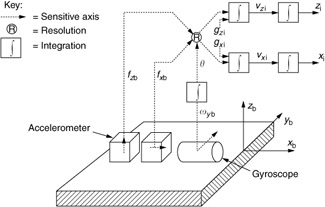
For the purposes of this discussion, it is assumed that a system is required to navigate a vehicle which is constrained to move in a single plane. A two-dimensional strapdown system capable of fulfilling this particular navigation task was introduced very briefly in Chapter 2 and is shown diagrammatically in Figure 3.1.
The system contains two accelerometers and a single axis rate gyroscope, all of which are attached rigidly to the body of the vehicle. The vehicle body is represented, in the...