Strapdown Inertial Navigation Technology, 2nd Edition

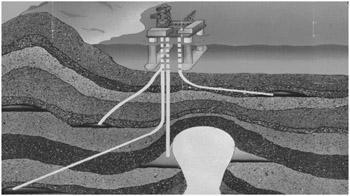
To extract hydrocarbons, such as oil and gas, from beneath the surface of the Earth, well bores are drilled by rotating a drill bit attached to the end of a drilling assembly. Most oil and gas exploration involves drilling highly deviated and substantially horizontal wells to increase production and to obtain additional hydrocarbons from Earth's formations frequently located several kilometres (horizontally) from beneath the drilling platform. This is illustrated in Figure 15.1.
There is a critical requirement for geological survey, mining and, in the drilling of oil and gas wells, to derive accurate representations of the well-bore trajectory. Such information is vital for:
cost-effective drilling;
the avoidance of well-bore collisions;
to allow precise relief wells to be drilled should the need arise.
Directional surveys provide definitive data that depicts the position of a borehole or well path in three-dimensional space. The only point in the path that is truly known and in most cases ever likely to be visible (some civil engineering and mining boreholes excluded) is the start point, generally referred to within the oil industry as the surface position, or the co-ordinates of the well head. The trajectory and position of the well as it progresses under ground is calculated by taking a series of directional surveys, which define the attitude of the well in space at a known measured depth down the well or along the well path. In its simplest form, the well...