Strapdown Inertial Navigation Technology, 2nd Edition

Appendix A: Kalman Filtering

The Combination of Independent Estimates

It is shown how best to combine two independent estimates of a variable to form a weighted mean value, this operation being central to the process of Kalman filtering [1, 2]. The following development assumes only a knowledge by the reader of elementary statistical principles. A full mathematical derivation of the Kalman filter is beyond the intended scope of this book. Therefore, the reader interested in a mathematical treatise on the subject is referred to the excellent text by Jazwinski [3].

The Single-dimension Case

Consider the situation in which two independent estimates, x 1 and x 2, are provided of a quantity x, where and are their respective variances. It is required to combine the two estimates to form a weighted mean, corresponding to the 'best', or minimum variance, estimate, . In general, the weighted mean may be expressed as:

(A.1)

where w 1 and w 2 are the weighting factors and w 1 + w 2 = 1. The expected or mean value of , written as E( ), is given by:

(A.2)

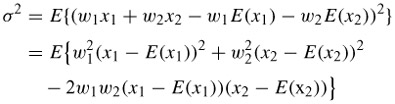
The variance of a quantity x is defined to be E[{ x - E( x)} 2]. Hence the variance of , denoted ? 2, may be written as:

(A.3)

Since x 1 and x 2 are independent, ( x 1 - E( x 1)) and ( x 2

UNLIMITED FREE
ACCESS
TO THE WORLD'S BEST IDEAS

SUBMIT
Already a GlobalSpec user? Log in.

This is embarrasing...

An error occurred while processing the form. Please try again in a few minutes.

Customize Your GlobalSpec Experience

Category: X-ray Sources
Finish!
Privacy Policy

This is embarrasing...

An error occurred while processing the form. Please try again in a few minutes.