TCP/IP Lean: Web Servers for Embedded Systems, Second Edition

Learn the "nuts and bolts" of programming for Web appliances with this in-depth guide.
 TABLE OF CONTENTS
 So far, the microcontroller Web server has been using a serial Serial Line Internet Protocol (SLIP) network interface. The next step is to adapt the server for use with Ethernet, and this chapter describes those adaptations.
Unfortunately, do-it-yourself hardware construction techniques are no longer applicable. A few chips hand-soldered on a prototyping board may have been adequate so far, but the use of 100-pin flatpack components puts you in a different hardware league. To provide a standard hardware base, I'll use the Microchip PICDEM.net [1] for all Ethernet experimentation, although the software could be adapted to other microcontroller networking platforms.
The Microchip PICDEM.net board also has a small amount of analog and digital I/O and an LCD display. These will be used for diagnostic purposes, although they are not essential to the operation of the networking software.
[1]PICDEM.net is the trademark of Microchip Technology Inc.
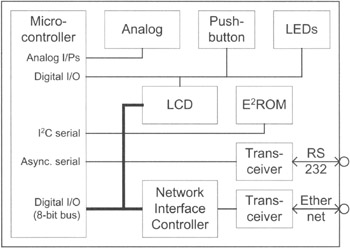
The demonstration board (Figure 12.1) has the following peripherals:
two-line by 16-character alphanumeric LCD display
two analog potentiometers
user push button
three light-emitting diodes (LEDs): one marked "system," two marked "user"
32Kb serial E2ROM
Ethernet interface
RS232 serial interface.
It would be difficult to drive all these peripherals using the same PIC16C76 as before. Instead, the 40-pin PIC16F877 is employed, which has
8K 14-bit words Flash program memory
368 bytes data memory
256 bytes nonvolatile E2ROM
eight-level hardware stack
10-bit analog-to-digital converter
Synchronous and asynchronous communication ports
three timers