TCP/IP Lean: Web Servers for Embedded Systems, Second Edition

Learn the "nuts and bolts" of programming for Web appliances with this in-depth guide.
 TABLE OF CONTENTS
 Even if you are only using TCP/IP to communicate between two computers side-by-side on the desktop, you still have to be aware of the underlying address structure, and that means understanding how the Internet works.
In this chapter I'll briefly delve into the structure of internetworks (of which the Internet is one) and the addressing structure they use. As a practical demonstration of this, I'll build a scanning utility that searches for addresses on the network and reports back what it finds. While networks are under the microscope, I'll look at the process of detecting and tracing network activity, for help in future debugging efforts.
All Ethernet networks are not the same: there are two main standards for the format of frames transmitted on the network. I'll enhance the scanning utility to accept this other format and see what difference it makes.
Prior to the creation of the Internet, it was believed that all networks must use switched circuits to create a unique link between two nodes. The prime example of this was the telephone network (Figure 3.1), which could link any two telephones using electrical relays or their electronic equivalent. The relays select a unique cabling path between sender and receiver, and this is maintained for the duration of the connection.
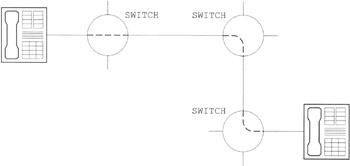
The radical step taken by the creators of the Internet was to arrange several possible paths between any two nodes and have the intervening switches (now called "routers") decide, on a