Telecommunications Quality of Service Management: From Legacy to Emerging Services

Examines the technical, service and human issues that need to be addressed in order to provide a level of QoS that will meet customer requirements.
 TABLE OF CONTENTS
 Network performance relates to the technical capability of the network in terms of the performance of particular combinations of items of equipment employed to deliver services. It is a major contribution to the QoS that customers experience when using the network. This chapter deals with network performance for legacy networks, that is, analogue and digital circuit switched networks. Performance aspects related to future ATM/IP networks and services are covered in other chapters, although the principles and some parameters are the same, for example, such networks often share a common transmission bearer network with legacy switched networks and hence their performance can be influenced by the transmission performance parameters.
Network performance is objectively measured by parameters meaningful to network operators and, in many cases, have a somewhat tenuous relationship to QoS perceived by customers. In some cases, several network performance parameters may contribute to the same impairment perceived by customers. Also, there are particular key parameters that fundamentally affect the quality of each service offered by the network, for example, error performance for data services and delay for voice services. These relationships are illustrated in Figure 9.1.
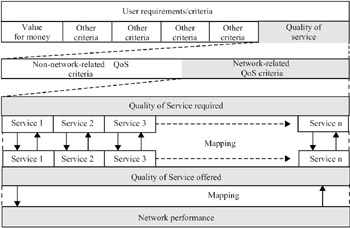
The relationship between QoS expectations and network performance parameters is shown in Figure 9.2. It should be noted that whereas performance parameters are well specified and measurable, QoS is a subjective awareness by customers that can vary depending on perceptions and expectations, and is very difficult to measure. Also, the term QoS is sometimes misused for...