Tony Redmond's Microsoft Exchange Server 2003 with SP1

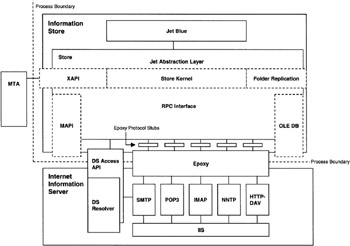
Figure 7.1 illustrates the internal structure of the Exchange Store, which is unchanged in Exchange 2003. The Store Kernel is the component that builds features unique to Exchange on top of the generalized Jet Blue engine. These features include single-instance storage, views, and automatic indexing of items as clients add items to the Store. The Jet Blue layer builds on top of the generalized ESE database engine. This layer takes responsibility for managing low-level internal structures such as the B-trees and class tables. ESE has no knowledge of high-level structures such as the schema used in any particular database. Instead, ESE operates at the page level to manipulate database contents.
We have referred to Jet, which stands for Joint Engine Technology, a generalized Microsoft database engine that Microsoft builds off of to form variants that drive products as diverse as the Store and Access. ESE is a much-enhanced development of the basic Jet engine now used by the AD and the DS. Apart from Exchange and Access, there are many other examples of Jet in use within Microsoft products. For example, Windows use Jet databases to hold WINS and DHCP data, and these databases share many of the characteristics you see in Exchange, including transaction logs and reserved logs. The original plan was for Jet to evolve to become a common technology platform for Microsoft databases, but this never materialized. In the future, Microsoft wants to achieve the...