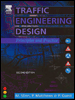
Traffic Engineering Design: Principles and Practice, Second Edition
Traffic engineering is used to either improve an existing situation or, in the case of a new facility, to ensure that the facility is correctly and safely designed and adequate for the demands that will be placed on it.
In an existing situation we have to know the present-day demands and patterns of movement, so that the new measure can be designed adequately. With a new road or facility, there is obviously no existing demand to base the design on; therefore, we have to estimate the expected demand.
If a new facility replaces or relieves existing roads, for example a bypass or a new cycle track, we can estimate the proportion of traffic that could be expected to transfer using a traffic assignment (see Chapter 4).
If the facility is completely new, for example a road in a new development, then the expected traffic and hence the scale of construction needed has to be estimated another way. This is usually done by a transport assessment (see Chapter 14) which will seek to assess the likely level of traffic by reference to the traffic generated by similar developments elsewhere. In either case the starting point will be a traffic survey.
The main reason for undertaking a traffic survey is to provide an objective measure of an existing situation. A survey will provide a measure of conditions at the time that the survey was undertaken. A survey does not give a definitive description of a situation for ever and...