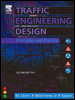
Traffic Engineering Design: Principles and Practice, Second Edition
The estimation of travel demand is a fundamental part of traffic engineering design work. The key questions are how much effort needs to be expended in estimating demand and what method should be adopted. The answers depend on the nature of the design issues. For example, a minor traffic management design to improve road safety over a length of road in inner London where traffic flows have been stable for many years will require little more than a survey of existing traffic. The reverse is true of a proposal for a new roadway to assist regeneration in an old urban area where design will depend on estimating the new traffic likely to be attracted to use the new road.
Estimation techniques fall into three main categories:
growth factor
low-cost manual estimation
computer-based traffic models.
All of these techniques include assumptions about the four basic elements of estimation, which are:
trip generation
trip distribution
modal split
assignment.
A 'trip' is defined as a one-way travel journey between the origin (start) and destination (end) of the journey. Trip generation is the number of trips starting or ending at an area (or zone) in a given time period, for example day or hour.
Trip distribution describes the number or proportion of trips from an origin zone spread among all destination zones.
Modal split is the split (or share) of these trips among different modes of travel (e.g. car, public transport, walk, cycle).
Assignment is the process whereby trips are routed from...