14.6 Accessibility Planning Using ACCESSION
ACCESSION is the new software provided by MVA to the DfT for use nationally in Accessibility Planning Activities (Figure 14.3).
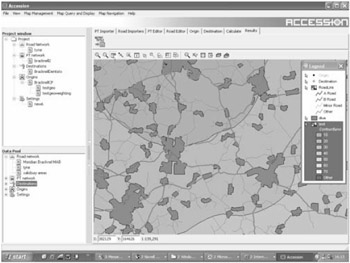 Figure 14.3: ACCESSION User Interface.
 It enables both the public and private sector to provide solutions which help tackle social exclusion, in development planning and in improving access by public transport.
Acquisition, preparation and application of appropriate transport, land use and socio-economic data are essential if accessibility analysis and audit is to be reliable. The information must also be consistent, sufficiently accurate and up to date.
To undertake an accessibility audit one needs to incorporate public transport datasets of bus stops and routeing data (in formats such as ATCO CIF), Census information and key origins and destinations in your area.
Accessibility Audits provide information on travel times by different modes (e.g. car, public transport, cycle and walk) and use GIS-based mapping to relate this to data on population, employment and a range of social criteria.
Local Authorities need Accessibility Audits to prepare action plans to tackle social exclusion, as an essential input to Development Frameworks and Local Transport Plans and as a tool for development control.
Health and Education service providers can make use of Accessibility Audits to plan the location of services and provide transport where access to services from areas of need is poor.
Public Transport Operators will find Accessibility Audits a useful tool in providing services in response to objectives and plans set by local authorities.
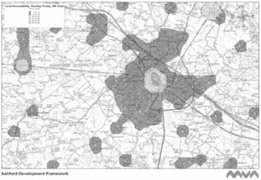 Figure 14.4: Ashford Local Accessibility.
 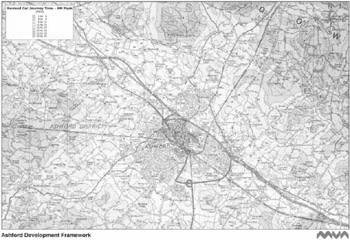 Figure...

 TABLE OF CONTENTS