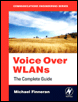
Voice Over WLANS

Dealing intelligently with WLAN voice requires a fundamental understanding of how the devices share the radio channel and transmit frames. The 802.11 protocols define the functions for Layers 1 and 2 of the OSI Reference Model. Layer 1 describes the radio transmission technique while Layer 2 defines the process for formatting and addressing frames and getting access to the shared channel.
While the convention in describing protocol options is to start at the bottom and work your way up, with WLANs it is easier to start at Layer 2 and work your way down. In this chapter we will describe the standards for the 802.11 media access control (MAC) protocol. The 802.11 MAC uses a technique called Carrier Sense Multiple Access with Collision Avoidance (CSMA/CD). CSMA/CA is a contention protocol, which means that all of the stations are vying or contending to access the channel. The result of that contention is the possibility that transmissions can collide in which case they must be resent.
The 802.11 MAC is based roughly on Ethernet s Carrier Sense Multiple Access with Collision Detection (CSMA/CD) protocol. Despite the similarity of the names, CSMA/ CA defines a very different mode of operation. Early on, wireless LAN designers found that they could not simply take these wired LAN approaches and transplant them to the wireless domain. One basic reason is the problem of collision detection. In a wireless LAN, when a station is sending, it cannot hear any other transmitters. Technically, a station must turn off...