Voice Over WLANS

7.6: Dissecting TCP/IP

7.6 Dissecting TCP/IP

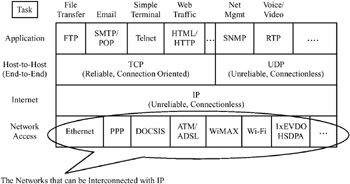
The major protocols in the TCP/IP model are shown in Figure 7-4. When we describe TCP/IP, we typically start with IP.


Figure 7-4: Major TCP/IP Protocols

7.6.1 Internet Protocol (IP; OSI Layer 3)

All traffic, voice or data, is formatted as IP packets called datagrams (Note: While datagram is the technically correct term, the terms packet and datagram are used interchangeably when describing IP traffic). Routers are the packet switches that forward those IP datagrams. Each router analyzes the address in the IP packet, and refers to a forwarding table it has stored in its memory. Routers use a set of forwarding rules called a routing protocol to decide where to send the packet next. The packet moves router-to-router until it reaches its destination. Those packets can then be forwarded through a variety of network services using a different access protocol for each.

7.6.2 Network Access (OSI Layers 1 and 2)

One of the key features of IP is the range of networks IP packets can be forwarded through. A Wi-Fi user at home could generate a packet containing part of an email message, a Web page request, or a sample of voice bits. That IP packet would be forwarded over a WLAN radio link to the user s home router. From there it could be forwarded in a DOCSIS frame over a cable modem service. At the cable head end, the packet might be sent in a PPP frame through the Internet backbone. When...

UNLIMITED FREE
ACCESS
TO THE WORLD'S BEST IDEAS

SUBMIT
Already a GlobalSpec user? Log in.

This is embarrasing...

An error occurred while processing the form. Please try again in a few minutes.

Customize Your GlobalSpec Experience

Category: Packet Generators
Finish!
Privacy Policy

This is embarrasing...

An error occurred while processing the form. Please try again in a few minutes.