Voice Over WLANS

7.3: OSI Layers and Functions

7.3 OSI Layers and Functions

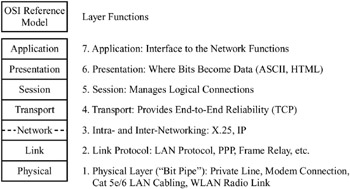
OSI provides a standard organization and vocabulary to define compatibility issues. To understand how the structure works, we begin with a brief description of the various layers and the functions they encompass. By convention, we begin at the bottom layer and work our way up. See Figure 7-1.


Figure 7-1: OSI Layers and Functions

7.3.1 Layer 1: Physical Layer

Layer 1 describes the transmission of bits over a physical medium. In the simplest terms, Layer 1 is the bit pipe over which our digital information will be sent. Layer 1 addresses such issues as physical connectors and the signal encoding. Depending on the media to be used, that encoding might be electrical, optical, or radio. In a wired LAN, the primary physical medium for desktop access is the Category 5e or Category 6 unshielded twisted pair (UTP) cabling. For example, a Layer 1 protocol for wired LANs would be 10 Base-T or 100 Base-T, which define how we encode the 1 bits and 0 bits as electrical signals to be transported over the cable path. In a wireless LAN, the radio link protocols, 802.11a, b, g, or n define the Layer 1 options.

7.3.2 Layer 2: Link Layer

The link layer provides rules for the transmission of data between devices over a single transmission link or through a single network. The link layer describes how transmission elements called frames are formatted, addressed, and how they are introduced onto the transmission link. LAN protocols...

UNLIMITED FREE
ACCESS
TO THE WORLD'S BEST IDEAS

SUBMIT
Already a GlobalSpec user? Log in.

This is embarrasing...

An error occurred while processing the form. Please try again in a few minutes.

Customize Your GlobalSpec Experience

Category: Protocol Stack Software
Finish!
Privacy Policy

This is embarrasing...

An error occurred while processing the form. Please try again in a few minutes.