E-Mail Virus Protection Handbook
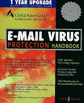
This book explains to end users, in plain language, what the threats are, and how to deal with them.
 TABLE OF CONTENTS
 At first, viruses were just annoying, then they started to corrupt the hard disk, and now they are stealing personal information. So what s next? One thing is sure: between the time this book is written and the time you are reading it, new malicious attacks will have surfaced. Fending off these attacks is difficult, because you re shooting at moving targets.
The three most serious types of attacks come through e-mail and/or the attachments sent with them, by surfing the Internet, and via security holes or bugs in software. Anti-virus applications help prevent the first two types of attacks.
This chapter will discuss the installation, configuration, and maintenance of the three most popular anti-virus applications for the PC, focusing in particular on the way these applications work with e-mail clients.
Although many people believe that the use of an anti-virus application should be mandatory, there are a lot of PCs that do not use any form of virus protection. If such a PC were not connected to the Internet, were not used for e-mail, did not have software of unknown origin installed, and did not come in contact with diskettes or recordable CD-ROMs, virus protection might be unnecessary but that would not be a realistic use of a PC. In this regard, the infamous Love Letter attack shows that two things are incontrovertible:
The first step in choosing an anti-virus application...