Embedded Systems Architecture: A Comprehensive Guide for Engineers and Programmers
In This Chapter
What an ISA is and what it defines
Discussion of the internal processor design as related to the von Neumann model
Introduction to processor performance
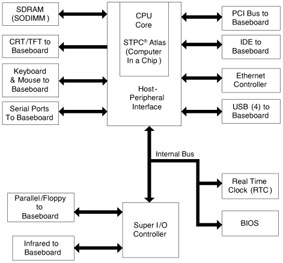
Processors are the main functional units of an embedded board, and are primarily responsible for processing instructions and data. An electronic device contains at least one master processor, acting as the central controlling device, and can have additional slave processors that work with and are controlled by the master processor. These slave processors may either extend the instruction set of the master processor or act to manage memory, buses, and I/O (input/output) devices. In the block diagram of an x86 reference board, shown in Figure 4-1, the Atlas STPC is the master processor, and the super I/O and ethernet controllers are slave processors.
As shown in Figure 4-1, embedded boards are designed around the master processor. The complexity of the master processor usually determines whether it is classified as a microprocessor or a microcontroller. Traditionally, microprocessors contain a minimal set of integrated memory and I/O components, whereas microcontrollers have most of the system memory and I/O components integrated on the chip. However, keep in mind that these traditional definitions may not strictly apply to recent processor designs. For example, microprocessors are increasingly becoming more integrated.
While some components, like I/O, may show a decrease in performance when integrated into a master processor as opposed to remaining a...