Embedded Systems Architecture: A Comprehensive Guide for Engineers and Programmers
In This Chapter
Introducing board I/O
Discussing differences between serial and parallel I/O
Introducing interfacing to I/O
Discussing I/O performance
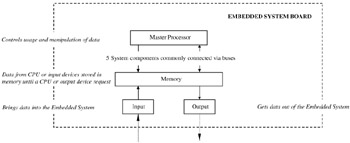
Input/output (I/O) components on a board are responsible for moving information into and out of the board to I/O devices connected to an embedded system. Board I/O can consist of input components, which only bring information from an input device to the master processor; output components, which take information out of the master processor to an output device; or components that do both (see Figure 6-1).
Any electromechanical system, both embedded and non-embedded, whether conventional or unconventional, can be connected to an embedded board and act as an I/O device. I/O is a high-level group that can be subdivided into smaller groups of output devices, input devices, and devices that are both input and output devices. Output devices receive data from board I/ O components and display that data in some manner, such as printing it to paper, to a disk, or to a screen or a blinking LED light for a person to see. An input device such as a mouse, keyboard, or remote control transmits data to board I/O components. Some I/O devices can do both, such as a networking device that can transmit data to and from the internet, for instance. An I/O device can be connected to an embedded board via a wired or wireless data transmission medium such as a keyboard or remote control, or can...