Embedded Systems Architecture: A Comprehensive Guide for Engineers and Programmers
Chapter 5: Board Memory

Overview

In This Chapter

  • Defining the various types of board memory

  • Discussing memory management of onboard memory

  • Discussing memory performance

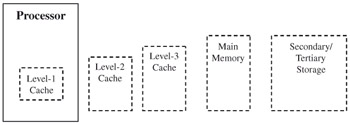
As first introduced in Chapter 4, embedded platforms can have a memory hierarchy, a collection of different types of memory, each with unique speeds, sizes, and usages (see Figure 5-1). Some of this memory can be physically integrated on the processor, like registers and certain types of primary memory, which is memory connected directly to or integrated in the processor such as ROM, RAM, and level-1 cache. Types of memory that can be integrated into a processor were introduced in Chapter 4. In this chapter, it is memory that is typically located outside of the processor, or that can both be either integrated into the processor or located outside the processor, that is discussed. This includes other types of primary memory, such as ROM, level-2+ cache, and main memory, and secondary/tertiary memory, which is memory that is connected to the board but not the master processor directly, such as CD-ROM, floppy drives, hard drives, and tape.


Figure 5-1: Memory hierarchy

Note: The material in this section is similar to material in Chapter 4 covering on-chip memory, since the basics of memory operation are essentially the same whether the memory is integrated into an IC or located discretely on a board.

Primary memory is typically a part of a memory subsystem (shown in Figure 5-2) made up of three components:

  • The memory IC

  • An address bus

  • A...

UNLIMITED FREE
ACCESS
TO THE WORLD'S BEST IDEAS

SUBMIT
Already a GlobalSpec user? Log in.

This is embarrasing...

An error occurred while processing the form. Please try again in a few minutes.

Customize Your GlobalSpec Experience

Category: Memory Chips
Finish!
Privacy Policy

This is embarrasing...

An error occurred while processing the form. Please try again in a few minutes.