Embedded Systems Dictionary
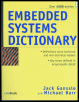
This dictionary defines the meaning and usage of 2,800 of the most-used terms in embedded systems in a way that serves technical and non-technical audiences alike.
 TABLE OF CONTENTS
 n. A mathematical constant representing the base of the natural log (ln). About 2.71828. See also exp().
See EEPROM.
adj. Describes a preemptive scheduling algorithm in which thread priorities are changed on the fly so that the thread with the shortest time remaining before its next deadline is selected to run. Abbreviated EDF. The ready thread with the most imminent deadline is guaranteed to be running every time. EDF scheduling can achieve higher processor utilization than RMA or any static priority scheme but requires the operating system to support dynamic priorities.
Unfortunately, EDF scheduling degrades poorly. If the system experiences a transient overload, it is impossible to predict which threads will miss their deadlines. For that reason, RMA is more commonly used in hard real-time systems, with the trade-off that more processing power must be applied to the problem to offset RMA s lower utilization.
Note that the deadline monotonic algorithm is different from EDF. DMA assigns static priorities based on deadlines so that each thread always has the same priority each time it runs. With EDF scheduling, a thread s priority can increase as its very next deadline draws near.
n. A hidden credits screen or other fun stuff that can be made visible only through a semisecret sequence of user inputs. Although fun for developers and some users, these are often removed from the final versions of products once management learns of their existence.
Example: If you have a Tektronix 1240 Logic Analyzer, try...