Fault-Tolerant Systems
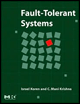
Reflecting the real-world challenges faced by designers of fault-tolerant systems, this up-to-date book addresses fault tolerance design with a systems approach to both hardware and software.
 TABLE OF CONTENTS
 Cryptographic algorithms are being applied in an increasing number of devices to satisfy their high security requirements. Many of these devices require highspeed operation and include specialized hardware encryption and/or decryption circuits for the selected cryptographic algorithm. A unique characteristic of these circuits is their very high sensitivity to faults. Unlike ordinary arithmetic/logic circuits such as adders and multipliers, even a single data bit fault in an encryption or decryption circuit will, in most cases, spread quickly and result in a totally scrambled output (an almost random pattern). There is, therefore, a need to prevent such faults or, at the minimum, be able to detect them.
There is another, even more compelling, reason for paying special attention to fault detection in cryptographic devices. The cryptographic algorithms (also called ciphers) that are being implemented are designed so that they are difficult to break. To obtain the secret key, which allows the decryption of encrypted information, an attacker must perform a prohibitively large number of experiments. However, it has been shown that by deliberately injecting faults into a cryptographic device and observing the corresponding outputs, the number of experiments needed to obtain the secret key can be drastically reduced. Thus, incorporating some form of fault detection into cryptographic devices is necessary for security purposes as well as for data integrity.
We start this chapter with a brief overview of two important classes of ciphers, namely, symmetric key and asymmetric (or public) key, and describe the fault injection attacks that can be mounted...