Fault-Tolerant Systems
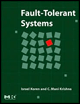
Reflecting the real-world challenges faced by designers of fault-tolerant systems, this up-to-date book addresses fault tolerance design with a systems approach to both hardware and software.
 TABLE OF CONTENTS
 At the heart of any simulation of probabilistic events is the random number generator, whose job it is to generate independent and identically distributed (i.i.d.) random variables according to some specified probability distribution function. The quality of such a generator is often critical to the accuracy of the results that the simulation produces, so that choosing a good generator is of considerable practical importance. We discuss in this section how to create random number generators and test their quality.
When faced with the need to generate a stream of i.i.d. random numbers according to some probability distribution function, we usually proceed in two steps. In the first step, we generate a stream of i.i.d. random numbers that are uniformly distributed in the range [0,1]; in the second, we transform these to fit the desired probability distribution.
In an ideal world, we would be able to generate truly random numbers that were both distributed uniformly over [0,1] and statistically independent of one another. If we can identify some physical process that displays the appropriate stochastic properties, we could simply take measurements of that process. For example, one commercially available generator amplifies the shot noise plus the thermal noise in transistors and then uses a thresholding function to convert that noise to bits (if the noise is above the threshold, it is a 1, otherwise it is a 0). This stream of bits is then processed to produce a sequence of numbers...