Fault-Tolerant Systems
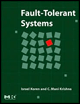
Reflecting the real-world challenges faced by designers of fault-tolerant systems, this up-to-date book addresses fault tolerance design with a systems approach to both hardware and software.
 TABLE OF CONTENTS
 Two textbooks on simulation [12,29], provide useful information on how to write simulation programs. Another, more elementary and limited, source is the operations research book [19]. A large number of topics related to simulation models can be found in [4]. Many simulations are written in special purpose simulation languages such as GPSS; for a good source for this language, see [30]. In our treatment, we did not discuss parallel simulation: this is a very promising approach to speeding up simulation. For details, see [14].
The topic of parameter estimation is covered in many books. See for example, [10,31]. [33] provides a readable section on the subject.
Perhaps the best sources for variance reduction methods are the two above mentioned books [13,29]. For importance sampling, see [15,18,26,27]. These also contain a useful bibliography. [25] provides an early source for the technique of forcing. A case study of the use of importance sampling in evaluating real time system dependability is presented in [11].
An excellent source of information about uniform random number generators is [23]. You can find there a detailed mathematical treatment of the properties of the linear congruential generator, including the relationships that must hold in order to have P = m. Especially valuable is the detailed treatment of statistical tests of randomness that is provided. The theoretical basis for the x 2 test is explained in detail, and the most powerful test of all the spectral test is covered extensively. This book also has an outstanding set of references...