Fault-Tolerant Systems
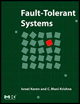
Reflecting the real-world challenges faced by designers of fault-tolerant systems, this up-to-date book addresses fault tolerance design with a systems approach to both hardware and software.
 TABLE OF CONTENTS
 The past 50 years have seen computers move from being expensive computational engines used by government and big corporations to becoming an everyday commodity, deeply embedded in practically every aspect of our lives. Not only are computers visible everywhere, in desktops, laptops, and PDAs, it is also a commonplace that they are invisible everywhere, as vital components of cars, home appliances, medical equipment, aircraft, industrial plants, and power generation and distribution systems. Computer systems underpin most of the world's financial systems: given current transaction volumes, trading in the stock, bond, and currency markets would be unthinkable without them. Our increasing willingness, as a society, to place computers in life-critical and wealth-critical applications is largely driven by the increasing possibilities that computers offer. And yet, as we depend more and more on computers to carry out all of these vital actions, we are implicitly or explicitly gambling our lives and property on computers doing their jobs properly.
Computers (hardware plus software) are quite likely the most complex systems ever created by human beings. The complexity of computer hardware is still increasing as designers attempt to exploit the higher transistor density that new generations of technology make available to them. Computer software is far more complex still, and with that complexity comes an increased propensity to failure. It is probably fair to say that there is not a single large piece of software or hardware today that is free of bugs. Even the space shuttle, with software that was developed and tested...