Fixed Income Mathematics

Offering explanations, exercises, and examples without demanding sophisticated mathematics, this self-teaching book will serve as a gateway to financial mathematics and to increased competence in business analysis.
 TABLE OF CONTENTS
 An annuity consists of a series of payments, starting at time t = 1 period and ending at time t = n periods. This annuity will have n payments. We assume that each of the payments is 1. The annuity will therefore have n equal payments of 1, each one period apart from the previous and from the next payment, and starting in one period. For payments unequal to 1, simply multiply the present value of the annuity by the amount of the payment.
The present value of each payment, made at time j, will be v j, with j = 1, ..., n, and v j indicating v raised to the power j, equal to the present value of the payment of 1 due at time t = j.
Therefore, the present value of the annuity will be
| (Equation 5.1) |  |
| (Equation 5.2) | 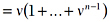 |
Using the algebraic factorization

If a = 1, and b = a, and dividing through by ( a b) ( a ? b and 1 ? v) , then
| (Equation 5.3) |  |
Substituting into Equation. 5.2, we have
| (Equation 5.4) |  |
(Note:  is called a angle n and indicates an annuity certain with n payments.)
Substituting v = 1/(1 + i), we have
| (Equation 5.5) | 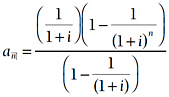 |
Multiplying numerator and denominator by (1...