Fixed Income Mathematics
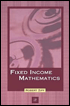
Offering explanations, exercises, and examples without demanding sophisticated mathematics, this self-teaching book will serve as a gateway to financial mathematics and to increased competence in business analysis.
 TABLE OF CONTENTS
 Many other types of fixed-income securities exist. Almost all of them use the equations and methods we have discussed earlier in this book, either the present value equation of the sort used to price bonds, or a discount yield of the sort used to price Treasury bills. When you examine the security, you should be able to figure out the mathematical equation for pricing it.
Here are two examples of other types of fixed-income securities, using pricing methods discussed earlier.
When you finish this chapter, you should have some understanding of how other types of securities might be priced, with these two examples.
A certificate of deposit (CD) represents a bank deposit. It has an interest rate, an amount, and a maturity date, so you can apply the standard calculation methods for bonds. A few CDs do not have a stated interest rate but are sold at a discount. To price these CDs, use the equations for T-bills.
CDs, of the sort we are considering here, are issued in multiples of $100,000. Because of their size, Federal Deposit Insurance Corporation Insurance does not apply, except to the first $100,000. They have a secondary market, and the owner can sell them if desired.
Years ago, all banks were considered to have about the same credit rating, but these days banks may have different credit ratings. As a result, CDs issued by different banks may trade at different prices. This practice is called tiering.
CDs pay interest at maturity...