Fixed Income Mathematics
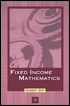
Offering explanations, exercises, and examples without demanding sophisticated mathematics, this self-teaching book will serve as a gateway to financial mathematics and to increased competence in business analysis.
 TABLE OF CONTENTS
 This chapter covers mortgage-backed securities. It starts with the definition of a mortgage, including the various terms used in discussions of mortgage investments, and the mathematics of mortgage calculations, including the equations to calculate mortgage payments, unpaid balances, and interest rates. The chapter then discusses how a mortgage pool is created and briefly describes some mortgage-backed securities. It looks at prepayment schedules and various prepayment models and examines the TBMA prepayment model, along with its equation. It then explains how duration and probability concepts can be applied to investments in mortgages and mortgage-backed securities.
When you finish this chapter, you should understand how mortgage calculations are done, at least some of the common mortgage investment vehicles, and the mathematics of investing in some mortgage investments.
A mortgage, of the kind we are discussing here, is a pledge of real property to provide security for a loan. Many different kinds of real property have been mortgaged, including railroad rolling stock and equipment and machinery, but mortgages of the sort we are examining in this chapter are pledges of housing. These are one- to four-family houses usually occupied by the owner who has mortgaged the property to buy it. A typical borrower is a home buyer who has bought the house to live in with his or her family.
Along with the mortgage, the owner has signed a note, which actually signifies the loan and states the terms of the loan. Usually, information about the mortgage is...