Fixed Income Mathematics

Offering explanations, exercises, and examples without demanding sophisticated mathematics, this self-teaching book will serve as a gateway to financial mathematics and to increased competence in business analysis.
 TABLE OF CONTENTS
 This chapter presents convexity as a development from duration and as a response to a need for better predictions of price changes as yields change than duration could provide. Convexity meets the needs for this increased prediction precision.
Mathematically, convexity is a natural development and extension of modified duration. We ll cover this factor mathematically in the next chapter, which contains a mathematical development of duration and convexity, as well as the mathematical basis for their use in price change predictions. This chapter presents the equation for convexity, shows how it is used, and gives some examples.
When you finish this chapter, you should understand the equation for convexity, how to compute the convexity of a bond, and how to make the convexity adjustment in estimating a bond price change for a given yield change.
The price/yield curve is convex, as illustrated earlier in chapter 6. We can measure this convexity, or degree of curvature, and, as a result, we can use the convexity to improve the predicted price.
The convexity (in periods) is as follows:
| (Equation 16.1) |  |
| (Equation 16.2) | 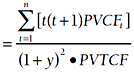 |
where
PVTCF = Present value of the total cash flow
PVCF t = Present value of the cash flow at time t
n = Total number of cash flows
y = Yield at which the cash flows are discounted, per period (Note that in this case y is the yield per period.)
For zero coupon bonds,
| (Equation 16.3) | 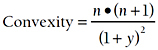 |
To calculate convexity in years, we use...