Gas Turbine Engineering Handbook, Third Edition
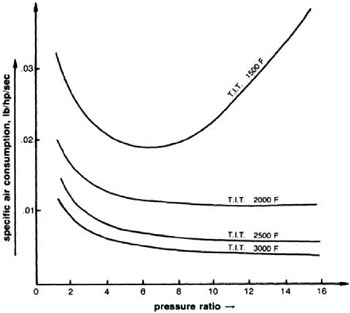
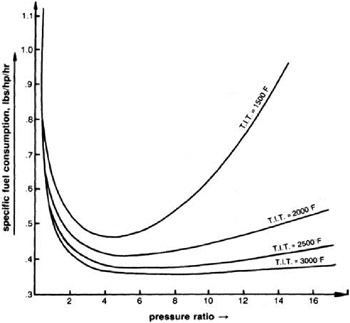
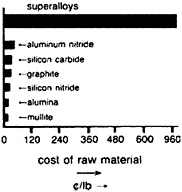
Temperature limitations are the most crucial limiting factors to gas turbine efficiencies. Figures 11-1a and 11-1b show how increased turbine inlet temperatures decrease both specific fuel and air consumption while increasing efficiency. Materials and alloys that can operate at high temperatures are very costly both to buy and to work on. Figure 11-1c shows relative raw material costs. Thus, the cooling of blades, nozzles, and combustor liners is an integral part of the total materials picture.
Since the design of turbomachinery is complex, and efficiency is directly related to material performance, material selection is of prime importance. Gas and steam turbines exhibit similar problem areas, but these problem areas are of different magnitudes. Turbine components must operate under a variety of stress, temperature, and corrosion conditions. Compressor blades operate at a relatively low temperature but are highly stressed. The combustor operates at a relatively high temperature and low-stress conditions. The turbine blades operate under extreme conditions of stress, temperature, and corrosion. These conditions are more extreme in gas turbine than in steam turbine applications. As a result, the materials selection for individual components is based on varying criteria in both gas and steam turbines.
A design is only as efficient as the performance of the selected component materials. The combustor liner...