Gas Turbine Engineering Handbook, Third Edition
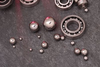
The bearings in gas and steam turbines provide support and positioning for the rotating components. Radial support is generally provided by journal, or roller bearings, and axial positioning is provided by thrust bearings. Some engines, mainly aircraft jet engines, use ball or roller bearings for radial support, but nearly all-industrial gas turbines use journal bearings.
A long service life, a high degree of reliability, and economic efficiency are the chief aims when designing bearing arrangements. To reach these criteria, design engineers examine all the influencing factors:
Load and speed
Lubrication
Temperatures
Shaft arrangements
Life
Mounting and dismounting
Noise
Environmental conditions
The aero-derivative gas turbine design, with its low-supported weight rotors for example, the LM 5000 HP rotor weighs 1230 lbs (558 kg) incorporates roller bearings throughout. These do not require the large lube oil reservoirs, coolers and pumps, or the pre-and post-lube cycle associated with journal bearing designs. Roller bearings have proven to be extremely rugged and have demonstrated excellent life in industrial service. Most bearings provide reliable service for over 100,000 hours. In practice, it is advisable to replace bearings when exposed during major repairs, estimated at 50,000 hours for gas generators and 100,000 hours for power turbines.
There are many roller bearing types. They are differentiated according to the direction of the main radial loads (radial bearings) or axial loads (thrust bearings), and the type of rolling...