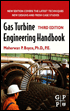
Gas Turbine Engineering Handbook, Third Edition
The performance analysis of the new generation of gas turbines is complex and presents new problems, which have to be addressed. Performance acceptance tests, which are required to be conducted for contractual guarantees, require that the turbine be cleaned before the test. The average commissioning time for the advanced gas turbine (G Type) units is longer than the F and FA Type units. This is usually due to the increased number of starts and trips during commissioning, due to a lot of fine tuning required for the DLN combustors, cooling systems, and complicated control systems, which increase the number of equivalent engine hours. It is recommended that contractually the maximum number of equivalent engine hours be limited to about 600 800 hours regardless of the actual equivalent operating hours. If this is not done then the power output will be corrected to a larger corrected output, reducing the actual power the plant will produce. There have been many cases of 2000 to 6500 equivalent operating hours recorded during commissioning, which in many cases amount to the power and heat rate being corrected by 2 to 5%. This affects the profitability of the plant.
The new units operate at very high turbine firing temperatures. Thus, variation in this firing temperature significantly affects the performance and life of the components in the hot section of the turbine. The compressor pressure ratio is high which leads to a very narrow operation margin, thus making the turbine very susceptible to compressor fouling. The turbines...