Gasification, Second Edition

5.2: FLUID-BED PROCESSES

5.2 FLUID-BED PROCESSES

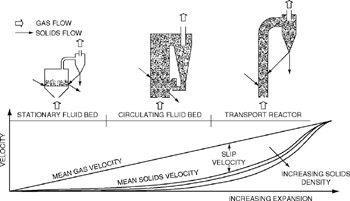
The history and development of coal gasification and fluid-bed technology have been intimately linked since development of the Winkler process in the early 1920s. Winkler's process operated in a fluidization regime, where a clear distinction exists between the dense phase or bed and the freeboard where the solid particles disengage from the gas. This regime is the classic or stationary fluid bed. With increasing gas velocity a point is reached where all the solid particles are carried with the gas and full pneumatic transport is achieved. At intermediate gas velocities the differential velocity between gas and solids reaches a maximum, and this regime of high, so-called "slip velocity", is known as the circulating fluid bed. Over the years gasification processes have been developed using all three regimes, each process exploiting the particular characteristics of a regime to the application targeted by the process development. These differences are portrayed in Figure 5.6.


Figure 5.6: Fluid-bed regimes (Greil and Hirschfelder, 1998)

In fluid-bed gasification processes the blast has two functions: that of blast as a reactant and that of the fluidizing medium for the bed. Such solutions, where one variable has to accomplish more than one function, will tend to complicate or place limitations on the operation of the gasifier, as in, for example, turndown ratio. These problems are especially severe during start-up and shutdown. In most modern gasification processes, oxygen/steam mixtures are used as blast. However, when the gas is to be used for power generation, gasification with...

UNLIMITED FREE
ACCESS
TO THE WORLD'S BEST IDEAS

SUBMIT
Already a GlobalSpec user? Log in.

This is embarrasing...

An error occurred while processing the form. Please try again in a few minutes.

Customize Your GlobalSpec Experience

Category: Adsorption Equipment
Finish!
Privacy Policy

This is embarrasing...

An error occurred while processing the form. Please try again in a few minutes.