Gasification, Second Edition

Chapter 7: Applications

7.1 CHEMICALS

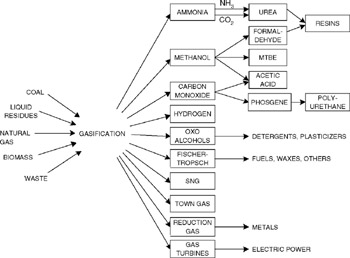
The two chief components of synthesis gas, hydrogen and carbon monoxide, are the building blocks of what is often known as C1 chemistry. The range of products immediately obtainable from synthesis gas extends from bulk chemicals like ammonia, methanol and Fischer-Tropsch products, through industrial gases to utilities such as clean fuel gas and electricity. Furthermore, there are a number of interesting by-products such as CO 2 and steam. As can be seen from Figure 7.1, many of these direct products are only intermediates towards other products closer to the consumer market, such as acetates and polyurethanes.


Figure 7.1: Applications for synthesis gas

Synthesis gas is an intermediate that can be produced by gasification from a wide range of feedstocks and can be turned into an equally wide range of products. Although every combination of gasifier feed and end product is theoretically possible, this does not mean that every combination makes economic or even technical sense. In North Dakota, synthesis gas generated from coal is successfully processed to manufacture synthetic natural gas (SNG). In Malaysia, partial oxidation of natural gas is used to generate the synthesis gas feed for a synthetic liquid fuels operation. Yet it would clearly make no sense to generate synthesis gas by partial oxidation of natural gas to manufacture SNG.

Given that this broad range of products is available from the single intermediate of synthesis gas, there is no technical reason why more than one product could not be produced from the same gas...

UNLIMITED FREE
ACCESS
TO THE WORLD'S BEST IDEAS

SUBMIT
Already a GlobalSpec user? Log in.

This is embarrasing...

An error occurred while processing the form. Please try again in a few minutes.

Customize Your GlobalSpec Experience

Category: Chemical Process and Petrochemical Gases
Finish!
Privacy Policy

This is embarrasing...

An error occurred while processing the form. Please try again in a few minutes.