Digital Signal Filtering, Analysis and Restoration
Illustrates some of the theoretical ideologies, offering alternatives to the practices currently in use on Digital Signal Filtering, Analysis and Restoration.
 TABLE OF CONTENTS
 The spectrum as defined by the integral Fourier transform for continuous signals does not exist for discrete signals. However, in Section 2.1 we introduced the notion of quasicontinuous signals which enable us to generalise the definition of the transform even to the discrete signals interpreted as limit cases of certain continuous signals. The relation (2.7) then gives the sampled-signal spectrum as an infinite sum of mutually shifted replicas of the original continuous signal spectrum.
The spectrum of the same signal can, with respect to the linearity of the Fourier transform, also be expressed as the sum of spectra of shifted and weighted Dirac impulses representing the individual samples,
| (3.1) | 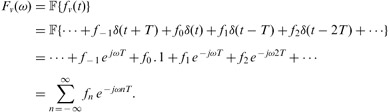 |
It is obvious that this expression is only based on the sample values and can therefore be calculated for a discrete signal in the form of a number series. The spectrum determined in this way could therefore be interpreted in the above-mentioned sense as the spectrum of the quasicontinuous signal. Based on these considerations is the following definition.
The Fourier transform of a discrete signal { f n} (or DTFT, discrete-time Fourier transform) is given by the expression
| (3.2) |  |
The transform is defined in the usual sense if the infinite sum converges for all real values ?, for which  is sufficient. As every signal of a finite length (with a finite number of samples) fulfils this requirement, the transform is defined for all finite signals (among...