Digital Signal Filtering, Analysis and Restoration
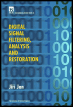
Illustrates some of the theoretical ideologies, offering alternatives to the practices currently in use on Digital Signal Filtering, Analysis and Restoration.
 TABLE OF CONTENTS
 The linear methods that we have mainly dealt with so far are still the primary means of signal processing. Their dominant role is given, on the one hand, by historical development as they are genealogically older and thus more broadly implemented, and the general degree of understanding, based on formalised analysis using common mathematical means, is higher. On the other hand, they are also theoretically and structurally simpler, which enables further development of the standard analysis and synthesis methods of the relevant algorithms and realisation structures in an easy to understand way. Their simple description makes the operation of signal-processing systems and possible system changes in time as with adaptive systems transparent for the user and easily applicable. The class of linear methods is defined by validity of the superposition principle; owing to this definition, the class is clearly delimited, the knowledge and approaches can be generalised well and the methods lucidly classified.
Nonlinear methods and systems, on the contrary, are delineated only negatively by invalidity of the superposition principle; therefore, they are all the methods and systems which remain after separating out the linear methods. This is of course a very vague demarcation, the consequence of which is that it is very difficult to formulate any generally applicable theorems and rules which would be valid in all nonlinear systems. Consequently, it is also impossible to provide general approaches of description, classification, analysis and synthesis of nonlinear methods. However, there are many different practical tasks...