Digital Signal Filtering, Analysis and Restoration

Illustrates some of the theoretical ideologies, offering alternatives to the practices currently in use on Digital Signal Filtering, Analysis and Restoration.
 TABLE OF CONTENTS
 Another approach to deconvolution is represented by the method of optimising the shape of a specially defined impulse response. It is based on the notion of a cascade connection of the given deteriorating system and the linear restoration filter to be designed. Such a cascade should ideally have a unit transfer, i.e. its overall impulse response should be (in continuous version) c( t) = ?( t). This cannot be practically achieved, as was shown in Section 10.2. However, it is possible to introduce a suitable criterion evaluating the shape of the impulse response and to then use this criterion in the optimisation process constrained by a condition limiting excessive increase in noise in consequence of restoration.
The method is formulated assuming continuous-signal degradation by the convolutional effect of a continuously working linear system and by additive noise; the discretisation (and usually A/D conversion) is included only at the input of the discrete restoration system. We suppose a known impulse response h( t) of the distorting system; the optimal impulse response { m n} of the FIR restoration filter of length M is to be found. The output signal of the complete chain can be represented quasicontinuously; for the overall impulse response expressed as convolution, we thus obtain
| (10.62) | 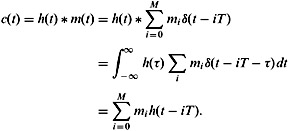 |
A suitable measure of restoration quality is the slenderness of the resulting impulse response c( t), characterised by the criterion
| (10.63) | 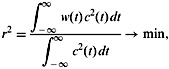 |
where w( t)...