Digital Signal Filtering, Analysis and Restoration

Illustrates some of the theoretical ideologies, offering alternatives to the practices currently in use on Digital Signal Filtering, Analysis and Restoration.
 TABLE OF CONTENTS
 As far as the influence of the linear system (distortion) prevails in the deterioration according to models (10.1) or (10.2), the purpose of restoration is primarily to compensate for the changes caused by the transfer of the signal through the system. The task is most easily formulated in the frequency domain: if the deterioration is given by the mentioned models and the noise level is low, the plain inverse filter can be considered for restoration. The transfer function M z( z) of such a (discrete) filter is given by the inverse of the transfer function of the distorting system,
| (10.3) |  |
The frequency response of the inverse filter is therefore
| (10.4) |  |
so that the estimate  of the spectrum X( ?) of the original signal will be, with respect to eqns (10.1) and (10.2),
| (10.5) |  |
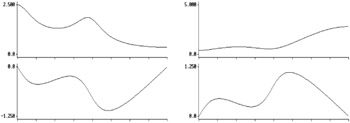
The middle expression allows for a vivid interpretation of the function of the inverse filter (Figure 10.4): it compensates for the unevenness of the frequency response of the distorting system so that the cascade connection of both systems has a uniform (unit) frequency response. Notice that the configuration of poles and zeros of the restoration filter is given by the configuration of the distorting system; only poles and zeros are interchanged.
Let us now analyse the cascade connection of both linear systems in greater detail. If the...