Management Extra: Quality and Operations Management
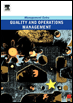
Exploring the associated concepts of quality and operations, this book fuses key ideas with applied activities to help managers examine and improve how they work in practice.
 TABLE OF CONTENTS
 Quality is not new. The Ancient Greeks used the word aret meaning excellence to define what they most admired physically and mentally in a man. Quality gradually became associated not just with human appearance and behaviour but also with the things they made. Craftsmen in the Renaissance used the word in their business to describe their highly finished and intricate jewellery, pottery, furniture silverware etc Now the word seems to be applied to virtually everything. Footballers score quality goals, we give our children quality time, we complain about the quality of television and the weather, we talk about quality experiences. So what do we mean by quality?
In this theme, you will:
Consider why quality concepts are important to organisational success
Assess how total quality management extends thinking on quality management
Explore two different standards for benchmarking of quality management systems.
The US army uses a strategic management approach called Total Army Quality (TAQ). This is aimed at the achievement of performance excellence through improvement, innovation, continuous learning and change.
Source: US Army (www)
As far as organisations and their products go, David Garvin (1984) has categorised five different definitions of quality based on the theories of quality gurus:
The transcendent approach-this is like aret , being synonymous with innate excellence , such as a quality player or quality diamond (24-carat). It's an absolute judgement.
The manufacturing-based approach-this is an approach associated with TQM guru Phillip B Crosby and is based on freedom...