Manufacturing Engineering Modular Series: Logistics and the Outbound Supply Chain

This publication explores the issues involved in distributing products from the manufacturer to the customer.
 TABLE OF CONTENTS
 Managing stock levels so as not to hold any more stock, and so not to incur any more cost than is necessary, but, at the same time maintain availability, is an important activity. Stock is held to meet demand between replenishment and also to cover against variability in demand and supply.
The stocks held to meet demand between replenishments is referred to as the primary or cycle stock; the stock held as contingency against variability is referred to as the secondary or safety stock (Figure 3.3).
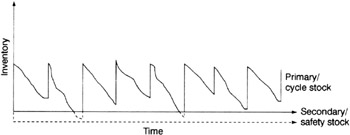
The cycle stock (primary) includes the stock held to meet demand between replenishments (this could be zero if replenishment is continuous on a just-in-time basis). It also includes the work-in-process stock and the delivery or in transit stock. The cycle stock may also include some anticipation stock, which is that stock bought into play to meet anticipated demand over and above the normal, or to allow for an anticipated shortfall in future delivery.
The safety stock (secondary) includes stock that is held as cover against possible variability of demand, possible variability of supply and also variability of process trigger.
Primary stock is there to provide availability between replenishments.
Replenishment may be either at a fixed delivery frequency (Figures 3.4 and 3.5) or to a fixed order quantity (Figure 3.6). When replenishing at a fixed frequency of deliveries, the objective is to order a quantity...