Manufacturing Engineering Modular Series: Logistics and the Outbound Supply Chain

This publication explores the issues involved in distributing products from the manufacturer to the customer.
 TABLE OF CONTENTS
 The final decades of the 20th century witnessed a significant expansion of global trade and the world became a smaller place.
Through radio, television, telephones (mobile and satellite), the Internet, etc., people and companies can communicate with each other, virtually instantaneously, across the world. Similarly, developments in air transport, containerization and the construction of long-distance bridges and tunnels such as Eurotunnel have made the movement of goods over longer distances much more feasible.
At the same time, the World Trade Organization, the EU, NAFTA, etc. have sought to remove the regulatory barriers to the movement of physical goods, workers and funds. The movement of information and digital products has become almost globally deregulated through satellite television and the Internet.
These developments have led in turn to the evolution of both global brands and global products. Manufacturers, competing on both price and quality, seek in turn centralization of production to gain economies of scale and concentration of technical expertise. The challenge of globalization of logistics is the inevitable consequence and the potential options open to a company in getting products from source to customer are numerous (Figure 6.1). The dramatic developments over the past few years of e-business has hastened this logistics challenge and made it more pressing to take up and overcome.
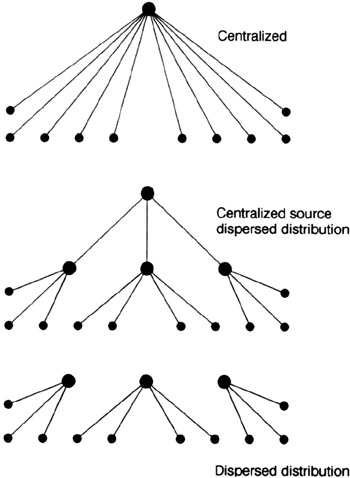
In framing an out-bound logistics strategy, a number of issues have to be faced and questions answered. Should there be a single centralized product source or should production be dispersed? Where...