Manufacturing Surface Technology: Surface Integrity & Functional Performance
The subject of surface technology means different things to different people. In the past, each engineer, scientist or technologist has observed surfaces from an individual viewpoint that emphasizes particular interests. However, surface technology cannot be considered the sole property of any one discipline because all are required to form the whole picture and fully define the surface.
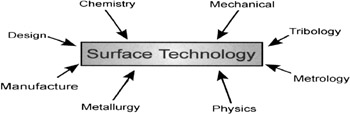
Figure 1.1 shows the disciplines that are related to or have an influence on surface technology. Whilst no single one can be highlighted in preference to others, in any particular situation one aspect may be dominant. Surface technology covers a wide field of subjects such as chemistry, tribology, mechanical design, metrology and metallurgy. There is a growing realization that surface technology must be recognised as a discipline in its own right. In this chapter, these specialist areas will be outlined to provide a foundation for manufacturing surface technology.
There are several reasons why surface technology is currently receiving attention in the engineering industry. Some of these areas are detailed below to set the scene and to highlight the various influences:
A realization of the importance of the manufacturing process as the final link in the design through manufacturing route. The manufacturing engineer has a renewed responsibility as the last person to touch a component before it leaves the factory. This is a reflection of the systems approach adopted by many companies. This manufacturing responsibility has...