Manufacturing Surface Technology: Surface Integrity & Functional Performance

Chapter 4: Surface Finish Characterization

4.1 Introduction

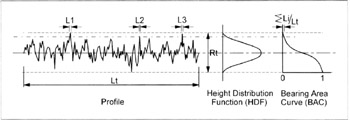
Once a satisfactory profile is obtained, it can be analysed and represented by a variety of means. This raises the question of what particular number, parameter or descriptor should be used. Unfortunately, there is no such thing as a universal parameter or descriptor and one must select from the hundreds that have been proposed over the years. In order to understand the range of parameters that can be used it is necessary to explain the amplitude distribution function (ADF) and the bearing area curve (BAC) (see Figure 4.1).


Figure 4.1: A surface profile and the associated ADF and BAC

The ADF is a histogram where the value of p(y) represents the fraction of heights lying in the stratum between y and (y + dy). If the ADF is integrated, the BAC or Abbott-Firestone curve or material ratio curve is obtained. The BAC can also be generated by slicing the profile in a straight line parallel to the mean from the highest peak down, plotting the total length revealed as a fraction of the profile length under consideration as is demonstrated in Figure 4.1. This is the equivalent of a perfect abrasion or wear process. The complement of the BAC is the cumulative height distribution (CHD), which results from integrating the ADF from the valleys up. Examples of the graphical outputs as well as parameters are shown in Figure 4.2. This is a stylus trace taken from a fine turned surface. The trace shows the conventional turning unit event...

UNLIMITED FREE
ACCESS
TO THE WORLD'S BEST IDEAS

SUBMIT
Already a GlobalSpec user? Log in.

This is embarrasing...

An error occurred while processing the form. Please try again in a few minutes.

Customize Your GlobalSpec Experience

Category: Surface Profilometers
Finish!
Privacy Policy

This is embarrasing...

An error occurred while processing the form. Please try again in a few minutes.