Manufacturing Surface Technology: Surface Integrity & Functional Performance
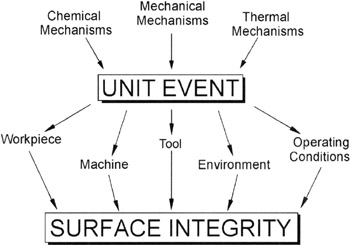
All manufacturing processes remove layers from a workpiece surface in some manner or other. This could be in the form of a continuous strip peeled from the surface as is the case in turning, in the form of small individual removals (eg electro-discharge machining (EDM)) or in the form of a dissolution of the whole exposed surface (eg chemical machining (CHM)). Whichever manufacturing process is employed, the method of removal will consist of a unique unit event, which has within it generating mechanisms that define the surface integrity (SI). The unit event will consist of chemical, mechanical and thermal mechanisms that, separately or in combination, remove material and generate a new surface, as shown in Figure 2.1. The unit event will not only include the primary mechanisms involved with the manufacturing process itself but also any secondary mechanisms such as reactions with the local environment after manufacturing, eg oxidation, absorption and environmental reactions. A unit event that is common within families of processes will be tailored by the specific operating conditions of the actual process, such as depth of cut, tool geometry, local environment, machine configuration, relative motion and material properties. The unit event will thus produce the surface integrity that will, in turn, determine the functional performance.