Modelling of Mechanical Systems: Discrete Systems, Volume 1
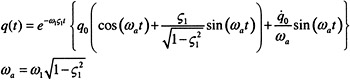
The response in the time domain of an oscillator to initial conditions is easily calculated by using the residue theorem. In the case of subcritical damping, which is of major interest for structural dimensioning against vibration problems, it is found that:

which identifies of course with the result already established in Chapter 5 by solving directly the differential equation of motion (cf. subsection 5.1.3.1).
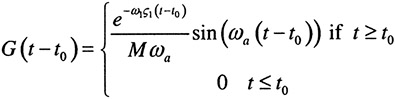
We consider now the response to a unit impulse occurring at time t 0. This response is known as a Green's function of the oscillator. It is given by:
| (7.59) | ![]() |
a result which can also be written as:
| (7.60) | ![]() |
G(t) is thus the inverse Laplace transform of the transfer function. This is not surprising since we have:
| (7.61) | |
The Green's function allows us to express the response of a harmonic oscillator to any transient excitation Q ( e )( t) as a convolution product. This is an immediate consequence of the convolution theorem (formula [A7.8] of Appendix 7) as applied to relation [7.23], which gives:
| (7.62) | ![]() |
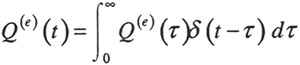
Physical understanding of such a result can be gained by splitting up Q ( e )( t) into a sequence of impulses. Indeed, it may be noted that:
| (7.63) | ![]() |
On the other hand, ? ( t - ?) can be obtained as the limit of a sequence of the...